PPDS announce that its Tableaux ePaper and 3000 Series EcoDesign digital signage displays have been selected to deliver a perfect tonic of high performance, low energy visual capabilities to Institut Pasteur’s 538,000 ft² biomedical research campus in Paris.
Founded by Louis Pasteur in 1887, the Institut Pasteur is an internationally acclaimed not for profit research and education institute committed to the fight against infectious diseases in France and around the world. A recipient of 10 Nobel Prizes and employing over 3,000 staff, the Institut’s colossal five hectare campus features 39 separate buildings, including a conference centre, and a total of 48,000 m2 of laboratory space.
Future proofed planning
With such a vast campus and visual technology playing an increasingly important role in its day to day activities and communications, Institut Pasteur’s AV/IT management team sought to modernise its ageing display infrastructure. Concluding an extensive site review, the project would include a fleet of 20x dynamic displays, strategically placed to support a variety of needs, settings, and light environments, including reception halls, meeting rooms, laboratories, and more.
The project presented a number unique challenges. As a site of historical significance – containing several listed buildings – retaining the aesthetics during any modernisation, while ensuring minimal disruptions to staff, was imperative. Furthermore, displays would need to meet the Institut Pasteur’s strict standards for electrical safety and durability, while providing greater energy efficiency to reduce its carbon footprint.
– Performance, readability, and energy efficiency were all key, with the displays disseminating scientific, institutional, and logistical information. For Institut Pasteur, and the invaluable work they do, there can be absolutely no compromise, commented Romain Gentile
Effective communication
Working with AV/IT integration specialists, Exaprobe, PPDS’ multi award winning ‘zero power’ 32” Philips Tableaux ePaper and 55” Philips Signage 3000 Series EcoDesign displays were immediately identified as the only solutions capable of meeting – and ultimately surpassing – the Institut’s high expectations.
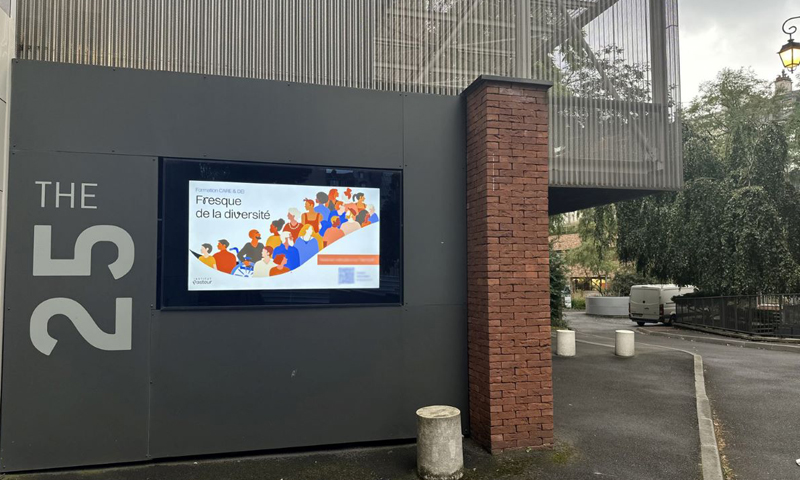
Signalling a new era of visual communications and sustainability, the introduction of Philips Tableaux ePaper displays was selected primarily – but not exclusively – to provide wayfinding 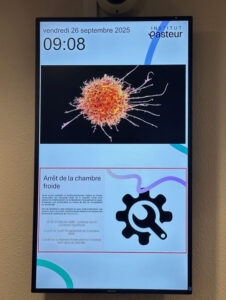 information, such as mapping, campus information, and other instructions, to help visitors navigate around the site.
Fully portable and able to be used entirely unplugged – ideal for use in Institut’s older buildings and in spaces with limited power sources – each Philips Tableaux is capable of displaying full colour, static imagery for days, weeks, months, or even years without using a single kilowatt of energy. The only time Philips Tableaux displays require power is during content updates, with one image change using just 0.0025 kWh.
The Gold standard
For the institute’s more advanced and detailed visual needs on a grander scale, including for presentations, corporate videos, and other internal communications, the future proof Philips Signage 3000 Series EcoDesign was the standout choice, ticking all boxes for both performance and sustainability.
In addition to delivering high impact 4K Ultra HD visual quality, with picture perfect performance down to the smallest detail – be that videos, pictures or numbers – the Philips Signage 3000 Series EcoDesign enables the screens to use less than 50 per cent of the power compared to other digital signage models in the market, without compromising on performance.